
Need Bollard Solutions?
Talk to our engineers about your security requirements.
Bollard Load Rating vs Crash Rating: What K12 and 40-Ton Mean
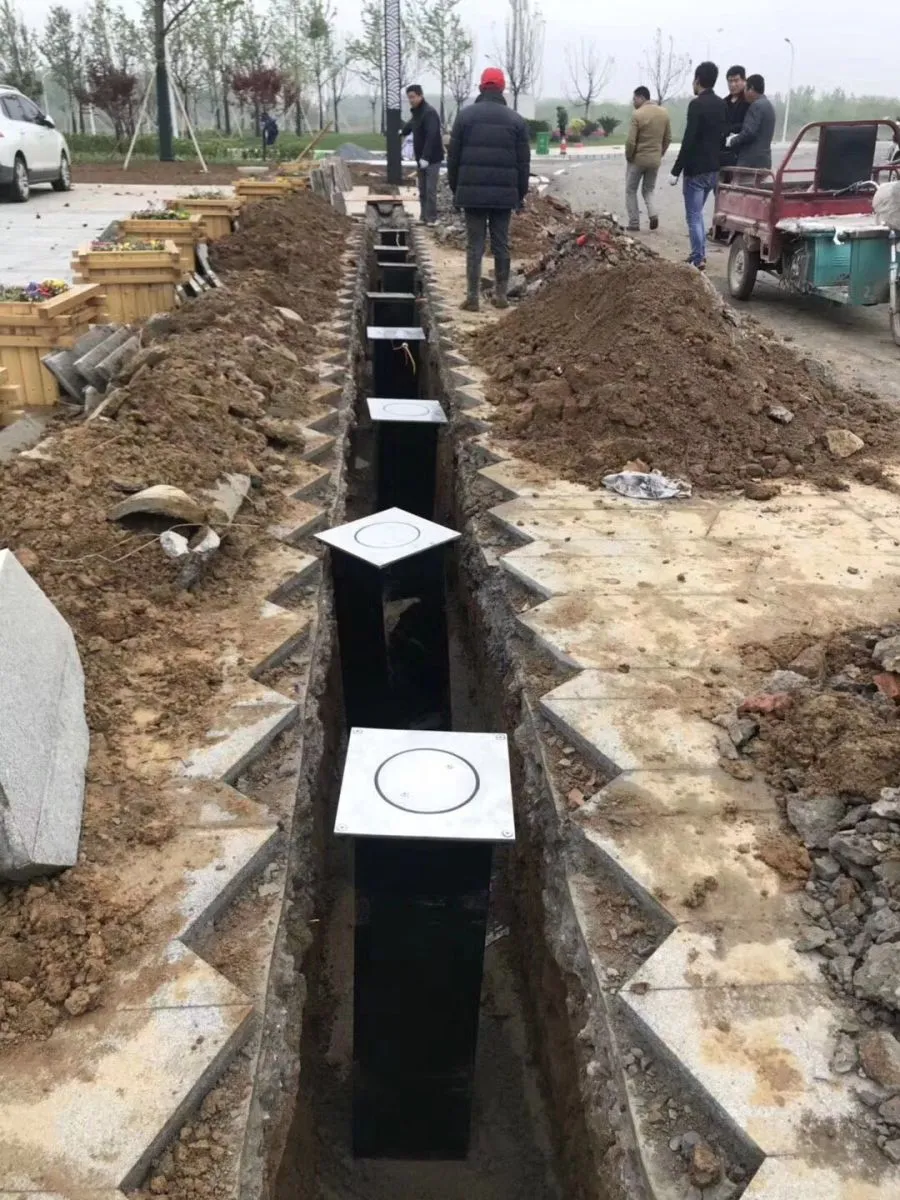
A bollard datasheet usually carries two numbers that look alike and mean nothing alike: a load rating, which describes what the unit carries in everyday traffic, and a crash rating, which describes the impact it has been tested to stop. Only the second is a certification, and it holds only when the unit sits on the footing, at the spacing and in the direction the test used.
What do the two numbers on a bollard datasheet actually measure?
Both figures are usually printed side by side, in the same font, with no explanation. Read them as two different load cases.
- Passage load is a service load. It describes the vehicle weight that can roll over or stand against the unit in daily operation — the container trucks, coaches and delivery vehicles that use the lane every hour. Our PM-HLC-S804B hydraulic rising bollard, for example, is rated for passage pressure from 40-ton container trucks, which is the reason it is used at logistics hubs, toll stations and industrial checkpoints.
- Crash rating is an impact result. It describes a single event: a test vehicle of a defined mass, at a defined speed, hitting the barrier at a defined point, with the outcome measured as penetration distance. The same PM-HLC-S804B is quoted at K12 (ASTM F2656 M50).
Those two figures can differ by an order of magnitude, because the physics differ. A 40-ton truck rolling over a bollard at walking pace loads it vertically through the column into the foundation. A 6.8-ton truck arriving at 80 km/h loads it horizontally, and the energy it must absorb grows with the square of the speed. A unit designed to survive the first case is not automatically proven in the second, and a unit proven in the second is not automatically rated for the first.
Why does “rated for 40 tons” get read as “stops a 40-ton truck”?
Because the passage figure is the one buyers see first, and tenders often copy it without the qualifier. The phrase usually comes from an application note — the lane handles 40-ton container trucks — not from a test report. When a specification ends up saying “bollard to stop 40-tonne vehicles”, the supplier has to decline or reinterpret it.
The fix is procedural, not technical: write both load cases into the specification as separate lines. One line states the maximum vehicle weight the lane must carry in daily operation; the other states the impact rating required, in the units of your market’s standard, with the penetration class you will accept. A supplier can answer both. Nobody can answer a single sentence that mixes them.
What does a K12 or M50 rating actually certify?
K-ratings came from the US Department of State’s anti-ram standard, which specified a medium-duty truck at increasing speeds: K4, K8 and K12 correspond to 30, 40 and 50 mph. ASTM F2656 replaced that logic with an M-rating plus a penetration class, so the same 50 mph test is written M50, qualified by how far the test vehicle penetrated — P1 being the shortest distance, up to 1 m in the common reference. The two labels describe one test family: the legacy language and the current one.
What the rating certifies is narrow. It certifies that this barrier model, on this foundation, at this spacing, stopped that test vehicle at that speed, with penetration inside the stated class. Change the foundation and you have changed the tested assembly. A one-page certificate with a logo is not evidence; ask for the test report and the foundation drawing that went with it. The standards themselves, and the difference between the Chinese GA/T and the ASTM route, are covered in our crash rating guide.
Which foundation does a crash-rated bollard need?
For a fixed or deep-foundation unit, the numbers are not negotiable once the model is chosen. On our YC-01 automatic rising bollard — 219 mm column, 600 mm lift, 1,100 mm embedment — the recommended concrete foundation is at least 800 mm × 800 mm × 1,200 mm, and detailed installation drawings are supplied with every order so the contractor builds to the tested dimensions rather than to an estimate.
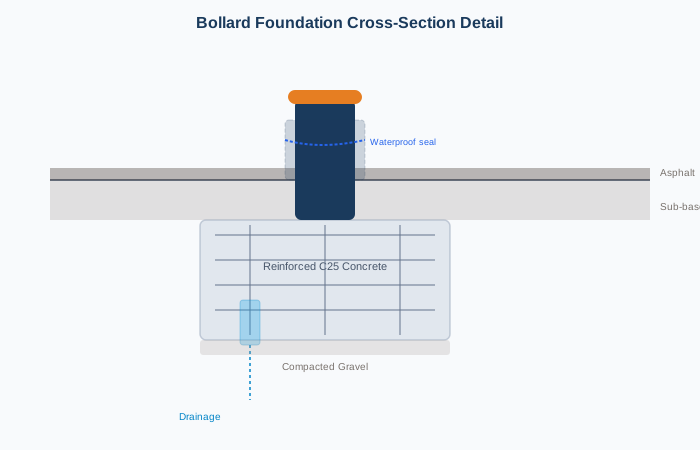
The drawing that comes with the unit is a cross-section, and reading it explains why the pit is deeper than the concrete block. A typical detail shows an excavation of about 800 mm across and 1,400 mm deep: a compacted gravel layer at the bottom, a reinforced C25 concrete base above it, the sleeve and column set into that base, and a drain plus a waterproof seal at the collar. Each layer exists because something fails without it.
| Layer in the detail | What it does | What fails without it |
|---|---|---|
| Compacted gravel base | Breaks the capillary path and gives the concrete a stable bed | Water collects under the base; frost heave lifts and tilts the unit |
| Reinforced C25 concrete | Takes the impact load from the column and spreads it into the soil | The column shears at grade, or the whole block rotates under load |
| Waterproof seal at the collar | Keeps surface water and grit out of the pit | Silt packs around the mechanism; the unit starts to jam |
| Drain pipe (at least φ50 mm on the S804B) | Carries water away from the pit | Standing water, corrosion, and ice locking the column in winter |
The same discipline applies to the electrical side: our S804B carries IP68 protection and a -35 °C to +75 °C operating range, but those figures describe the unit, not a pit that fills with water because the drain was left out. Embedment differs by model — 1,100 mm on the YC-01, a 160–300 mm ground socket on the YC-05 removable bollard — so build to the drawing for your model.
Why are the footing and the spacing part of the rating?
Because impact energy leaves through the foundation. A certified bollard bolted to a thin existing slab has the same column and a completely different load path: the anchors concentrate the load into a few hundred millimetres of concrete, and the slab cracks or the anchors pull before the column even deforms. Some approved-product lists go further and require that a crash-rated bollard share one reinforced foundation with its neighbour, because the assembly that was tested relied on that shared mass.
Spacing works the same way. The tested assembly has a defined geometry, so a lane laid out wider than the test configuration leaves a gap a vehicle can aim at, while bollards set too close to a wall or kerb sit on a slab that is weaker on one side. Set the lane width from the vehicle mix you actually expect and keep a sensible clearance from walls, kerbs and openings; our spacing and layout guide walks through the dimensions.
Can a shallow foundation still be crash rated?
Yes, where a tested shallow configuration exists — and only then. Shallow-mount rising bollards are designed for sites where deep excavation is impossible: dense underground utilities, historic districts, high water tables, retrofit projects where the surface cannot be opened for long. Our shallow-mount series uses a reduced embedment, is available in automatic or semi-automatic configuration, and is built in 304 stainless steel with IP68 protection.
Two cautions. First, the embedment depth of a shallow-mount unit is model- and site-dependent — ours is quoted per project, so send the site conditions and ask for the drawing rather than assuming a number. Second, a shallow-mount product is not automatically crash rated: ask for the test report of the shallow configuration itself, not of the deep-foundation version of the same brand, and check that the foundation drawing in the report matches the one you will build.
A removable bollard in a 160–300 mm ground socket is a different product again: a traffic-management tool for closing a bay, marking a pedestrian zone or changing a layout seasonally, and it should not be specified as a crash barrier.
What should the site survey confirm before you order?
- What is underground. Water, gas, power and telecom lines decide whether a deep pit is even possible, and therefore whether the project needs the shallow-mount series.
- Where the water goes. Water table height, drainage fall and the nearest gully. A pit with no outlet will be a maintenance item for the life of the installation.
- What the surface is made of. Asphalt over a slab, block paving over hardcore and a poured concrete apron are three different excavation and reinstatement jobs.
- Which vehicles use the lane. The heaviest vehicle in daily service sets the passage load; the threat vehicle sets the crash rating. They are usually not the same vehicle.
- The lane geometry. Width, approach angle and the distance to walls or kerbs, all marked on the drawing before anything is saw-cut.
The step-by-step sequence from survey to handover is in our installation guide.
What belongs in the RFQ?
Six lines turn a vague enquiry into a quotation you can compare and, later, hold a supplier to.
| Item | Ask for | What it proves |
|---|---|---|
| Test report | Barrier model, test vehicle mass, speed, penetration class, test house and date | That a rating exists, and what exactly was tested |
| Foundation drawing | The drawing used in that test: pit dimensions, concrete grade, reinforcement, drainage | That the rating survives installation |
| Installation drawing for your model | Embedment depth, pit size, cable entries | That the contractor builds the right hole |
| Drainage detail | Drain size, fall and outlet, collar seal | That water is designed out, not discovered later |
| Spacing and clearance | Minimum distance to walls, kerbs and openings | That the lane geometry matches the tested assembly |
| Load cases, written separately | Passage load in tonnes; impact rating in the standard of your market | That nobody conflates the two numbers |
Frequently asked questions
Is a K12 rating the same as M50?
They describe the same test family in different languages. K12 comes from the legacy Department of State anti-ram standard and means a medium-duty truck at 50 mph; ASTM F2656 writes the same test as M50 and adds a penetration class. Ask for the report rather than the label, and read the vehicle mass, speed and penetration distance for yourself.
Can a crash-rated bollard be anchored to an existing concrete slab?
Only if that slab is engineered as the tested foundation — thickness, reinforcement, anchorage depth and enough mass to resist the impact. Anchoring to a thin slab concentrates the whole load into the anchors. If the surface cannot be replaced, ask for a shallow-mount configuration with its own test report instead of improvising a base.
Does a deeper foundation make the bollard stronger?
Up to the tested design, depth and reinforcement decide how the impact load is spread into the soil. Beyond it, extra depth does not upgrade the rating, because the rating belongs to the assembly that was tested. Build the drawing you were given; if the site forces a variation, ask the factory to confirm it in writing.
What does a “40-ton” rating mean on a bollard, then?
It means the unit is built to carry 40-ton vehicles in normal traffic — rolling over it, idling against it, crossing the lane every day. That is a structural statement, not an impact rating, and it is no substitute for a crash rating in a specification.
Which numbers should I check before signing?
The ones that will be built: embedment depth, pit dimensions, concrete grade, drain size, and the distance from the first and last bollard to the walls or kerbs. If any of them differs from the drawing that came with the test report, the rating no longer applies to your installation.
Guardix builds fixed, automatic, semi-automatic and shallow-mount bollards, including the K12 hydraulic S804B and the YC-01 series quoted above. Send the lane drawing, the heaviest vehicle in daily service and the impact rating your project needs, and we will come back with the model, the foundation drawing and the test report — see the crash-rated range, the shallow-mount option, the manual and semi-automatic range, or send your project details.


